Homicide in England and Wales, Part 7: Homicide enhancers
This is the last in a series of blog posts summarising the nature of homicide in England and Wales. Each post covers a different aspect of homicide, based on data from the Home Office Homicide Index. This post looks at some common enhancers of homicide: drugs, alcohol, mental health, gangs and organised-crime groups. This post is a summary of part of a longer national problem profile of homicide in England and Wales written by me and Prof Iain Brennan.
NoteWhat are ‘enhancers’ of crime? (click to expand)
Enhancers are factors that increase the likelihood of severity of a crime occurring. They intensify existing crime opportunities by making offending easier, increasing the rewards of offending, or otherwise pushing people towards committing a crime. The term enhancers comes from the book Reducing Crime by Jerry Ratcliffe. Common enhancers for many types of crime include drugs and alcohol, technology or design that makes crime easier, situational factors such as how places are managed, and social conditions such as crowds.
I’ve already mentioned some enhancers of homicide in other posts in this series. For example, Part 3 of this series looked at the different weapons and other methods used in homicide.
Homicide is often driven by drugs or alcohol
Drugs and alcohol are associated with homicide in a variety of ways. A third of victims were under the influence of drugs and/or alcohol at the time of the homicide: 27% had been drinking alcohol and 15% had taken an illicit drug, while 8% were under the influence of both drugs and alcohol.
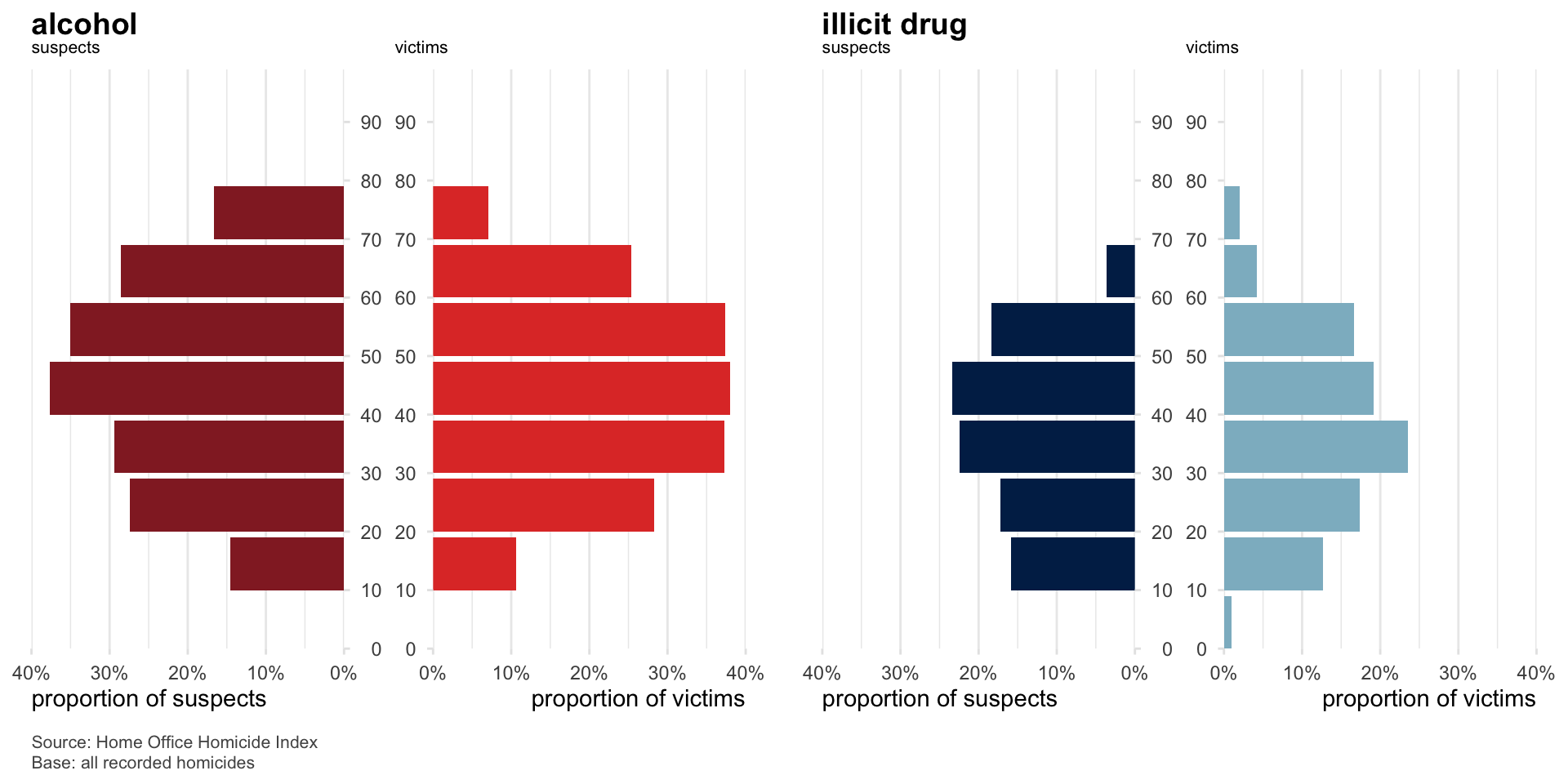
Similarly, a third of suspects were under the influence of drugs and/or alcohol: 26% had been drinking and 18% had taken an illicit drug, while 11% were under the influence of drugs and alcohol. Overall, 64% of cases were related to drugs and/or alcohol through either the victim and/or a suspect: 11% were related to alcohol alone, 30% were related to illicit drugs alone and 22% were related to both. Both victims and suspects were more likely to be under the influence of alcohol if they were middle aged, while being under the influence of illicit drugs was more common for younger adult victims (Figure 1).
Victims were more likely to have been drinking in homicides related to fights, brawls, etc. (42%) than in other homicides (27%), while suspects were more likely to have been drinking in homicides related to fights, brawls, etc. (33%) and in domestic homicides (32%) than in other cases (26%). Victims were more likely to have taken an illicit drug in homicides related to a reckless act (34%) than in other homicides (15%), while suspects were more likely to have taken an illicit drug in homicides related to an irrational act (35%) than in other cases (18%).
Homicides are sometimes linked to illicit drugs even when neither suspect nor victim were known to be under the influence at the time of the incident. For example, 34% of homicide victims were known to be users of illicit drugs. While ‘drug user’ in the Homicide Index data is not precisely defined, this is much higher than the 9.5% of all adults who say they have used an illicit drug in the past year1. Drug users were at higher risk of homicide even in cases where it had not been identified that the victim had taken an illicit drug at the time they were killed: 24% of victims who had not taken an illicit drug were nevertheless known to be drug users.
Overall, 64% of cases were related to drugs and/or alcohol through either the victim and/or a suspect
Homicide suspects were even more likely to be known drug users, with 48% of suspects for whom this information was recorded being known to use illegal drugs, including 38% of suspects who were not believed to be under the influence of drugs at the time of the homicide. Among the cases where the drug-user status of both victims and suspects was known2, both the victim and at least one suspect were known to be drug users in 27% of homicides, while either the victim or at least one suspect were known drug users in 53% of homicides.
There was also a clear relationship between suspect and victim drug use: in cases where at least one suspect was a drug user, there was a 57% chance the victim was also a drug user, while in cases where the suspects were not known drug users, there was only a 13% chance the victim was a drug user.
People believed by police to be drug dealers were also at elevated risk of being involved in homicide, either as a victim or suspect: 16% of victims were believed to be drug dealers, along with 28% of suspects. Either the victim or a suspect were believed to be drug dealers in 29% of homicides for which that information was known3, and in 11% both the victim and at least one suspect were believed to be drug dealers. Drug dealers were particularly likely to be victims of homicide in certain circumstances: 54% of people killed during robberies were believed to be drug dealers, along with 43% of people killed as a result of long-running feuds (long-running feuds were also linked to gang homicides – see below).
A sixth of homicides are linked to suspect mental health
Overall, in 17% of homicides the senior investigating officer judged that the homicide was linked to the mental health of one or more suspects. The likelihood of a homicide being linked to the mental health of female suspects was broadly similar whether the victim was male or female, while for male suspects, homicides were more likely to be linked to suspect mental health if the victim was female (29% of such cases) than if the victim was also male (11% of such cases).
Homicides were much more likely to be linked to suspect mental health in some circumstances than others. Mental health was particularly likely to be a factor in homicides related to irrational acts (75% of homicides were linked to suspect mental health) or domestic abuse (34% of homicides). Conversely, mental health was only very rarely a factor in homicides related to the suspect committing another crime (2% of homicides were linked to suspect mental health), reckless acts (3% of homicides were), or child abuse (4% of homicides were).
Homicides were more likely to be linked to suspect mental health in cases that were also linked to illicit drugs. Suspect mental health was a factor in 25% of homicides where the suspect had taken an illicit drug (whether or not they had also been drinking), compared to 15% of homicides where the suspect was not under the influence of drink or drugs, and 14% of homicides where the suspect had been drinking but had not taken drugs.
Only a small minority of homicides are related to gangs or organised crime
The Home Office changed how they recorded information about organised crime groups (OCGs) and street gangs half-way through the period covered by this analysis. Until March 2021, the data contained a field stating whether or not the police believed a homicide to be gang related. From April 2021, the same information is instead recorded for each suspect individually, meaning that whether a homicide was believed to be gang-related or not was not recorded for homicides where there were no recorded suspects. At the same time, a new field was introduced stating whether or not police believed a homicide to be related to an OCG, but there is no indication in the data of whether homicides recorded before April 2021 were believed to be OCG-related or not.
Of those homicides that occurred up to March 2021, 10% were believed to be gang related. Gang-related homicides were heavily concentrated among younger victims: 34% of homicides of victims aged 10–19 were gang-related, along with 22% of homicides of victims aged 20–29. They were also heavily concentrated among male victims: 14% of homicides of male victims were gang-related, compared to only one homicide of a female victim. The proportion of gang-related homicides also varied by victim ethnicity: 36% of homicides of Black victims (and 11% of homicides of Asian victims) were gang-related, compared to 5% of homicides of White victims were believed to be gang related. Combining data on age, sex and ethnicity shows some groups in society were much more likely to be victims of gang-related homicides than others: Black men aged 20–29 were 49 times more likely to be the victim of a gang-related homicide than White men of the same age, while Black men/boys aged 10–19 were 35 times more likely to be the victim of a gang-related homicide than White men/boys of the same age.
Black men aged 20–29 were 49 times more likely to be the victim of a gang-related homicide than White men of the same age
Of all the offenders in homicides believed to be gang-related, all but 1 were male. Offenders in gang-related homicides were also very likely to be young: 90% of gang-related offenders were 29 years old or younger (and 54% were 19 or younger), compared to 51% of offenders being 29 or younger in non-gang-related homicides. Half of all offenders in gang-related homicides were Black (in non-gang-related homicides, 15% of offenders were Black), while only 32% of offenders in gang-related homicides were White (compared to 70% of offenders in non-gang-related homicides).
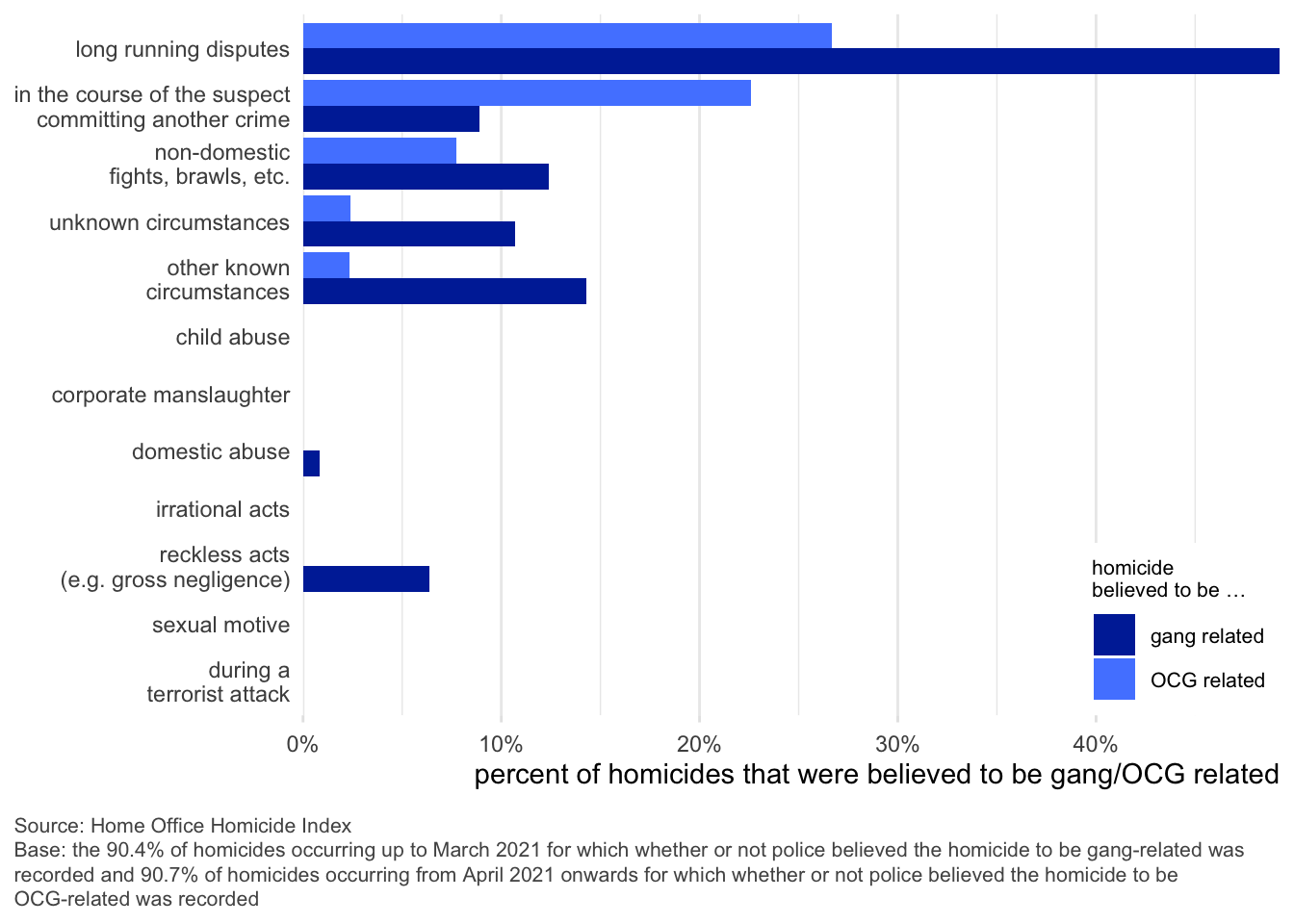
Police were more likely to believe homicides were gang- or OCG-related in some circumstances (Figure 2). than others. Gang-related homicides were more likely than other homicides to involve the use of a firearm (30% of gang-related homicides, compared to 3% of homicides that were not gang related) and more likely to involve the use of a sharp instrument (64% of gang-related homicides, compared to 41% of homicides that were not gang related). Suspects in gang-related homicides were more likely than those in non-gang-related homicides to have a previous serious conviction in all age groups.
While the data after March 2021 does not specify whether a homicide was gang-related or not, records of homicides after that date include a new variable specifying whether or not a victim or suspect was believed to be part of a gang. Among homicides recorded after April 2021, 8% of victims and 19% of suspects were believed to be part of a gang. Overall, the victim and/or at least one suspect were believed to be gang members in 10% of homicides. Suspects believed to be in gangs were much more likely to be involved in homicides of victims who were also believed to be in gangs: in homicides of gang members, 28% of suspects were themselves believed to be gang members, compared to only 3% of suspects in homicides of non-gang members.
Suspects believed to be in gangs were much more likely to be involved in homicides of victims who were also believed to be in gangs
In every homicide where the victim or a suspect were believed to be in a gang, the victim was male. Similarly, 97% of suspects in cases linked to gangs were male.
There was a strong link between gang affiliation and illegal drugs: 70% of victims identified as gang members were also believed to be drug users (compared to 30% of victims who were not gang members), while 68% of victims identified as gang members were also believed to be drug dealers (compared to 11% of victims who were not identified as gang members).
Homicides in which the victim or a suspect were believed to be gang members were particularly likely to have occurred in certain circumstances: 71% of homicides resulting from long running disputes were gang-related by this measure (homicides in long-running feuds were also much more likely to be linked to drugs), as were 26% of homicides that occurred in the course of another crime.
Of the homicides that occurred from April 2021 onwards, 5% were related to organised-crime groups. The limited number of OCG-related homicides mean it is hard to discern any patterns, although all victims and suspects in OCG-related cases were male. OCG-related homicides were particularly likely to occur in certain circumstances: 25% of OCG homicides related to long running disputes and 20% of OCG homicides were committed in the course of another crime. OCG-related homicides were also more likely to involve a firearm (22% of OCG-related homicides) and/or a sharp instrument (66% of OCG-related homicides).
In summary
Homicides very often involve either the victim and/or a suspect being under the influence of alcohol or illicit drugs. This isn’t surprising: in Part 2 of this series I mentioned that the most-common circumstances in which homicides occur is during fights and brawls, which are often aggravated by alcohol or (some types of) illicit drugs.
Drug users are at much higher risk of being homicide victims than other people in society. Less than 10% of people in England and Wales say they have used an illicit drug in the past year, but a third of homicide victims were known to be drug users and 15% were known to have taken an illicit drug at the time they were killed. People involved in drugs supply were also at very-high risk of homicide, especially where the homicide was linked to gangs or OCGs.
References
Office for National Statistics. 2023. Drug Misuse in England and Wales: Year Ending March 2023. Office for National Statistics. https://www.ons.gov.uk/peoplepopulationandcommunity/crimeandjustice/articles/drugmisuseinenglandandwales/yearendingmarch2023.
Footnotes
Based on estimates of the proportion of people aged 16–59 years interviewed for the Crime Survey for England and Wales who have used an illicit drug in the past 12 months (Office for National Statistics 2023).↩︎
Whether a person was believed to be a drug user or not was recorded for 96.8% of victims and 56.4% of suspects.↩︎
Whether a person was believed to be a drug dealer or not was recorded for 96.5% of victims and 56.1% of suspects.↩︎