Homicide in England and Wales, Part 1: Homicide in Context
This is the first in a series of blog posts summarising the nature of homicide in England and Wales. There’s a lot to cover, so I’ve broken it down into a series of seven blog posts. Each post will cover a different aspect of homicide:
- Homicide context (this post)
- Victims of homicide
- Homicide offenders
- Homicide methods
- Homicide hotspots
- Homicide vulnerability
- Homicide enhancers
There will be lots of data in these posts, but it’s important to remember that every homicide is a tragedy for the victim and their friends and family. Every data point in these posts represents a human being. These are some of the 1,869 victims of homicide in England and Wales whose cases are included in this analysis.

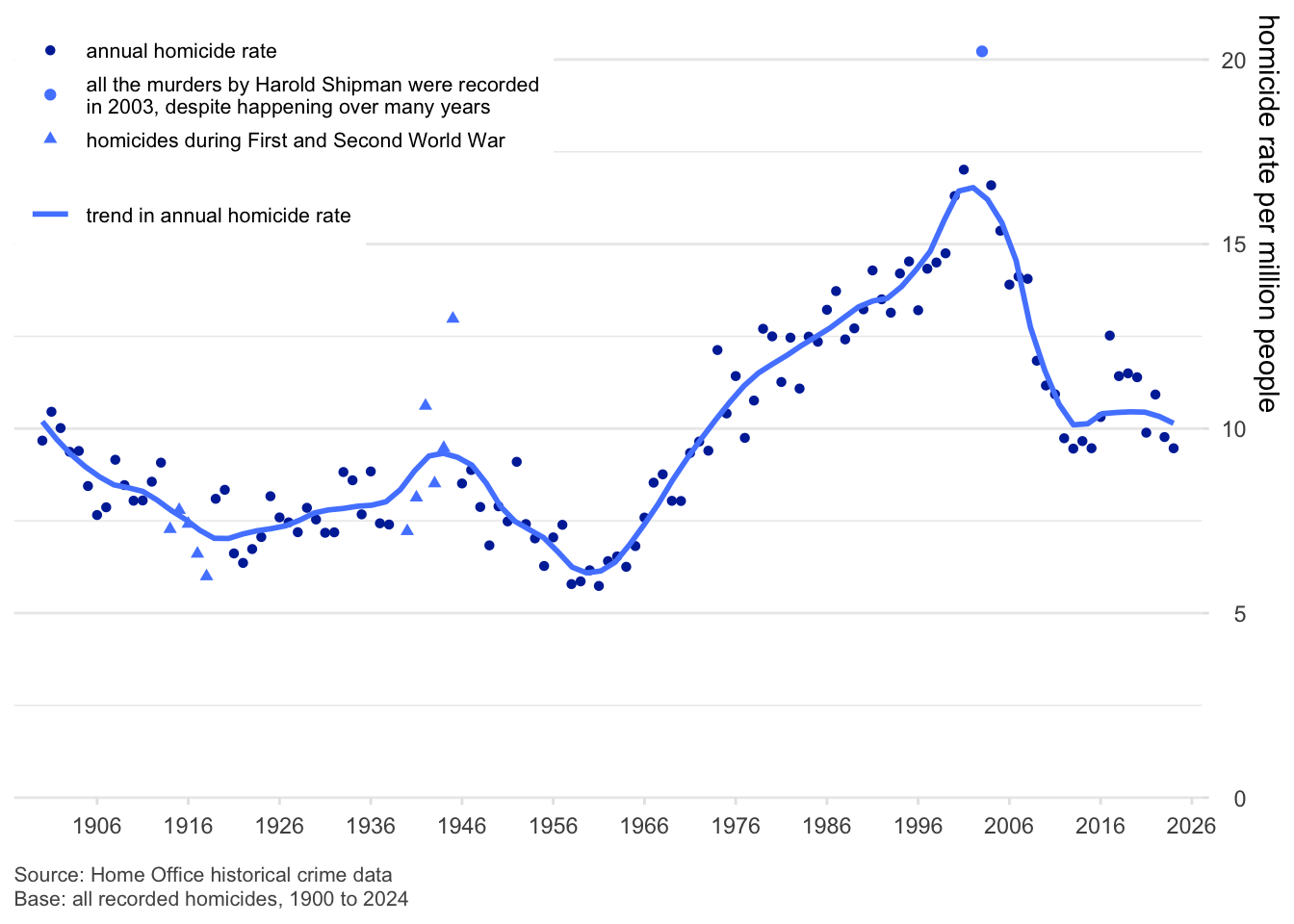
Homicide rates have dropped over the past 30 years
Compared to many countries around the world, homicide in England and Wales is rare. Since 1900, the rate of homicide in peacetime has fluctuated between a low of 5.7 per million people in 1961 and 17.0 per million people in 2001 (Figure 1). In simpler terms, around one in every 100,000 people is murdered each year in England and Wales. The homicide rate for 2024/25 was 9.5 homicides per million population – 569 homicides across 60.1 million people. The homicide rate in 2024/25 was among the lowest since the mid 1970s.
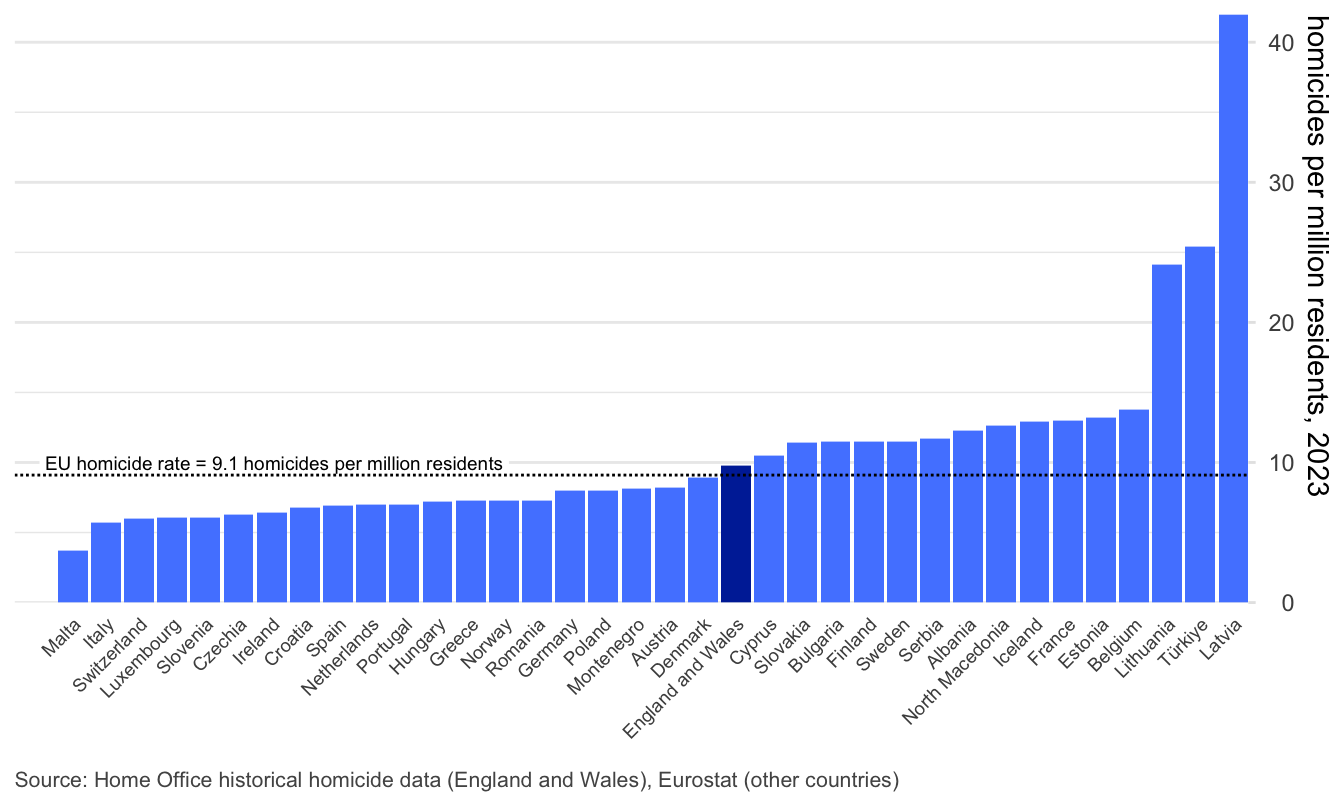
The homicide rate in England and Wales is close to the European average
For comparison, in 2023, within the 36 countries of Europe the homicide rate in England and Wales (9.8 per million people) was ranked 16th – very similar to the European Union homicide rate of 9.1 per million (Figure 2).
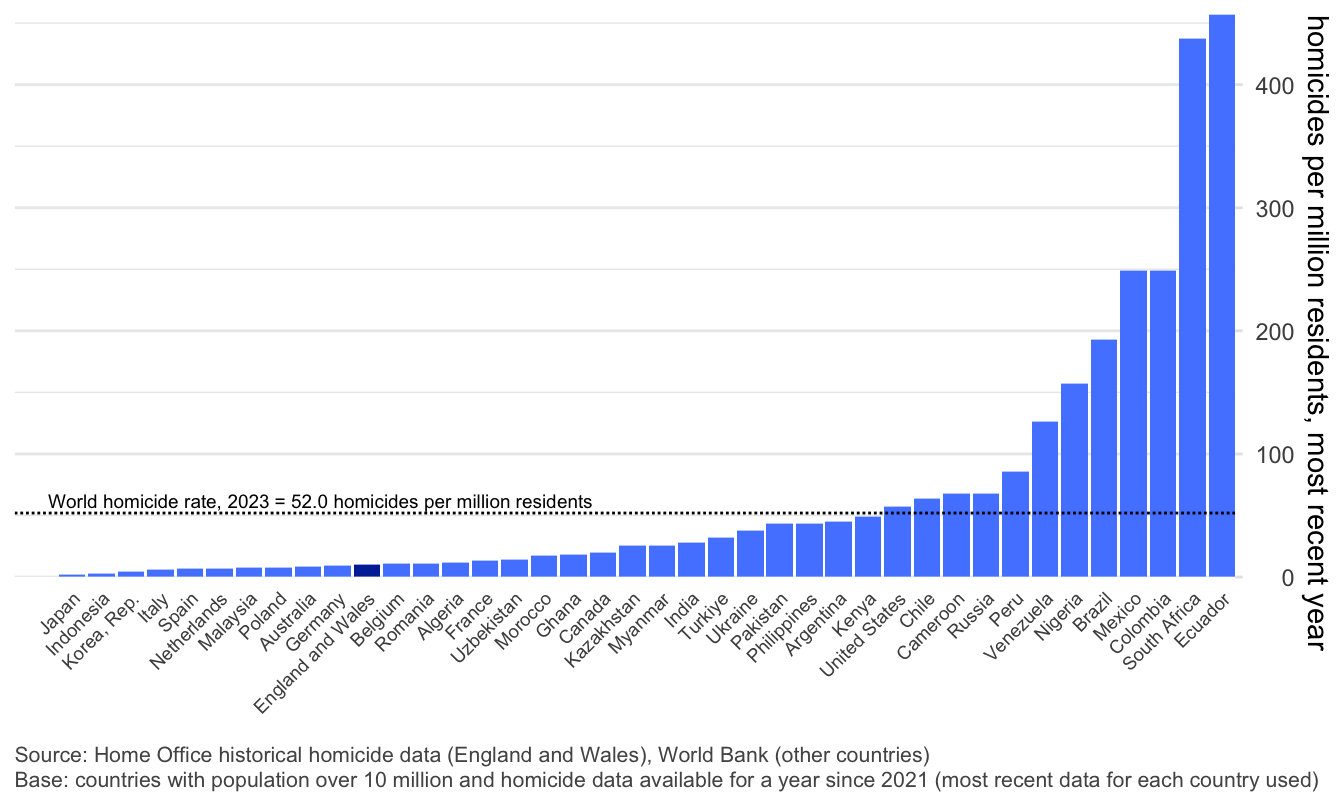
Homicide in England and Wales is lower than in many other countries
Looking further afield, the homicide rate in England and Wales is about one-fifth of the global homicide rate (Figure 3) and about one-third of the homicide rate in high-income countries as a whole. Compared to England and Wales, the homicide rate in the United States is about six times higher and the rate in Canada is two times higher. However, there are a small number of developed countries with substantially lower homicide rates: the rate in Japan is one-fourth the rate in England and Wales.
Despite its relatively infrequent nature, the societal cost of homicide is extremely high, with unquantifiable emotional costs for victims’ families, as well as millions in medical expenses, investigation, punishment and lost economic output. Extrapolating from the latest Home Office estimate of the costs of crime, the estimated societal cost of homicides in 2024 was around £2.44bn.
A note on how these posts were put together
This series of blog posts is based on data from the Home Office Homicide Index, a national dataset containing details of every homicide recorded in England and Wales. The Home Office provided access to the data as part of a collaboration between the College of Policing and University College London to produce a national problem profile for homicide. The analysis was done by me and Prof Iain Brennan at the University of Hull. The Homicide Index is only one source of information about homicide, so it is possible that analysis based on other sources might produce slightly different results.
The profile is based on the most-recent three years of data available at the time it was written: 2019/20 to 2021/22. This data might seem slightly outdated, but homicide investigations can take many months so there is sometimes a substantial lag between a homicide occurring and full details of it being included in the Homicide Index. Some analysis uses data from earlier years to provide context or comparison.
The period of data analysed for this report include the coronavirus pandemic which began in late 2019. The pandemic affected patterns and distributions of many types of crime, but it does not appear the pandemic had a substantial effect on the frequency of homicide.
These blog posts summarise the national problem profile. They do not contain all the detail that is in the full problem profile report, which is available from the College of Policing website. The full report also contains recommendations for police practice based on the analysis.
Homicide sub-types
Separately from the national homicide problem profile, the Home Office has grouped homicides into set of seven homicide problem sub-types, i.e. groups of incidents that share a common set of characteristics, such as victim age and sex, victim-perpetrator relationship and where it took place (Table 1).
To help understand how some homicide characteristics vary for different types of homicide, the national problem profile uses the sub-types developed by the Home Office.
| Problem sub-type | Description |
|---|---|
| 1 | Female victims of domestic homicide (offender is a partner/family member, victim is aged 16+) |
| 2 | Male victims of domestic homicide (offender is a partner/family member, victim is aged 16+) |
| 3 | Male victims up to age 25 killed in a public place |
| 4 | Female victims of non-domestic homicide aged 16+ |
| 5 | Male victims of non-domestic homicide aged 25+ killed in a public space |
| 6 | Male victims of non-domestic homicide aged 25+ killed in a house/dwelling |
| 7 | Victims under 16 killed in a non-public place (house, residential home, other location or unknown location) |
| other | All other victims of homicide |
The next post in this series looks at victims of homicide.